A Polar Bear Swam With a Seal Carcass in Its Mouth. The Camera Shows It Could Not Eat It.
In September 2019 a collar camera recorded a female polar bear swimming in Hudson Bay with a dead seal. The study's findings on swimming bears explain why this was not the windfall it looks like.
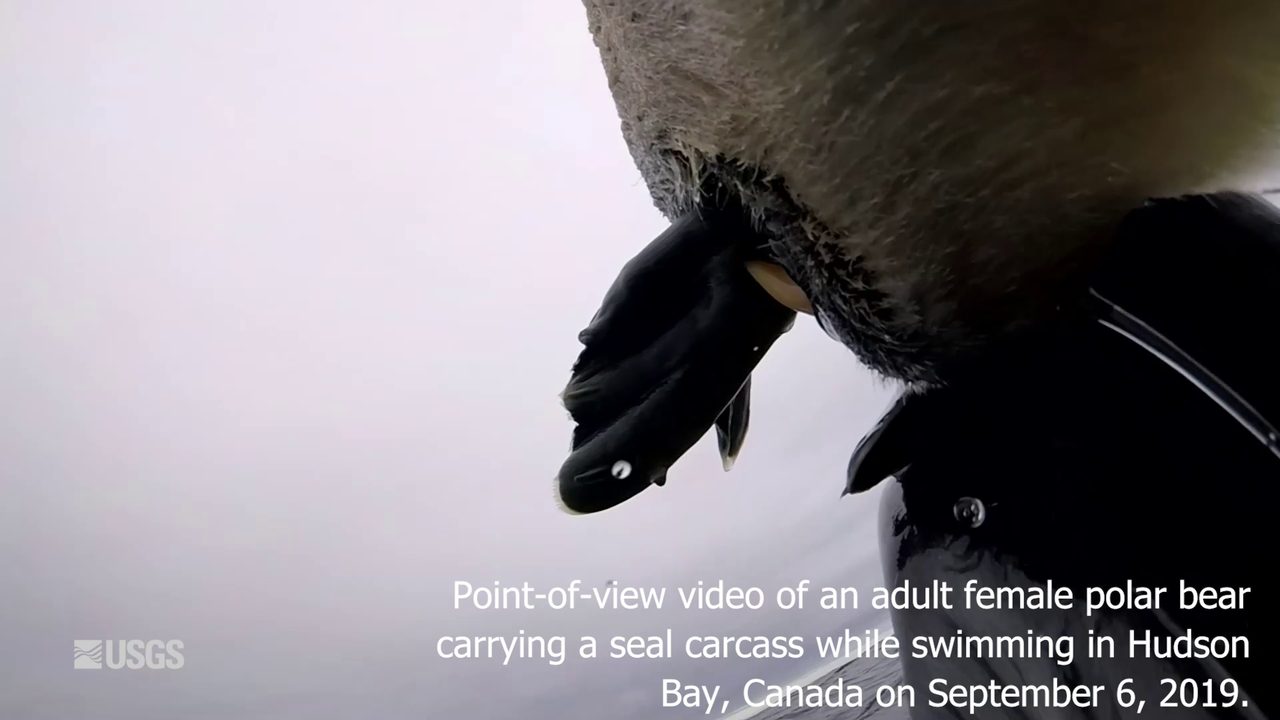
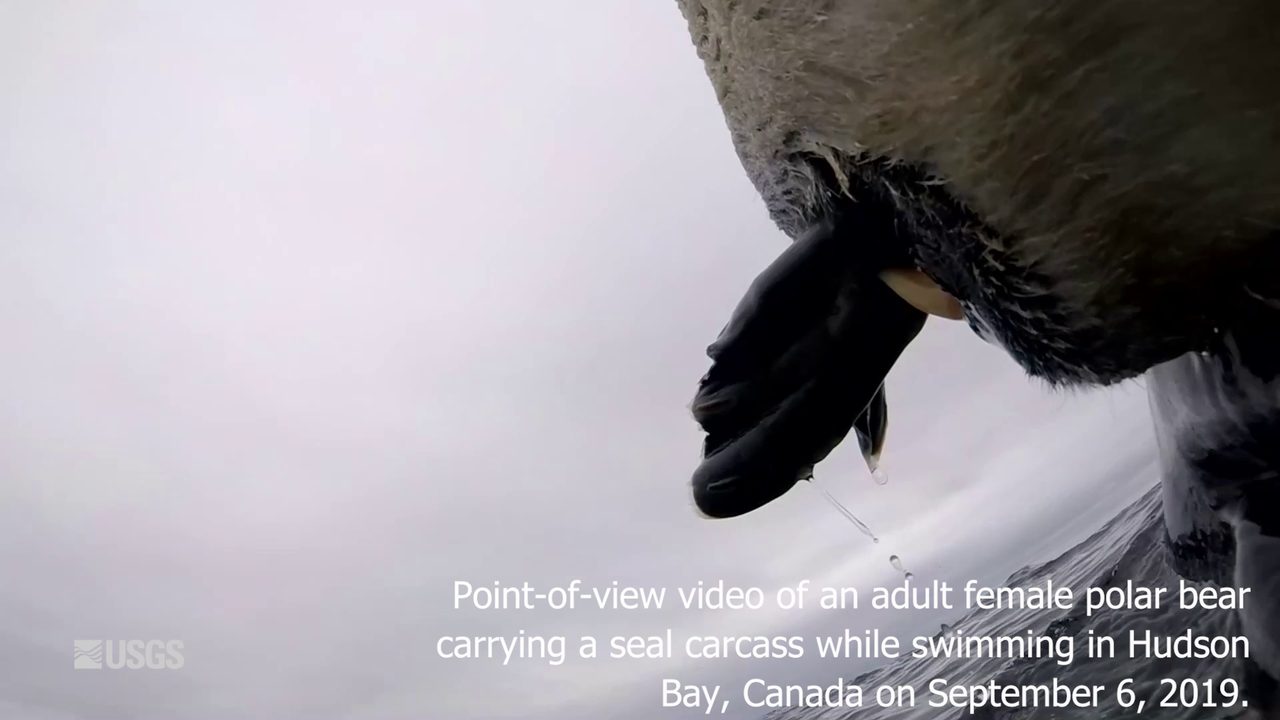
USGS labels this clip a point-of-view video of an adult female polar bear carrying a seal carcass while swimming in Hudson Bay on September 6, 2019. The camera is on her collar, so the flipper at the edge of the frame is part of what she has in her jaws.
What the swimming study found
The footage belongs to the 2019–2022 study of 20 bears summering near Churchill, Manitoba. Three of the bears made long swims, and one covered 175 kilometers (about 110 miles) across the bay. Two of them found carcasses in the water, a beluga and a seal. Neither could feed on the find while swimming, and neither brought it back to land.
The study text reports that one young female used a beluga mostly as a float and fed on it for about 35 seconds. Another female swam about 120 kilometers, found a seal during a seven-hour swim and fed for roughly 20 seconds. USGS's caption for this clip does not say that she is that second bear, so treat the match as possible, not confirmed.
The numbers behind the frame
Pagano has said one adult or subadult seal can supply a polar bear with enough energy for about 7 to 10 days. That is why a carcass in the water matters, and why a bear that cannot eat it while treading water gets so little out of it.
On land the picture can be different. CBC reported that a four-year-old male, whose video collar failed, showed in blood tests that he had eaten a large marine mammal carcass washed up on shore. The study's only weight gain among the 20 bears came from a bear that found a dead marine mammal on land. A carcass on a beach is a meal; a carcass in open water is mostly something to hold on to.
Why long swims are expensive
USGS notes that tracking data from long-distance swims suggest polar bears do not stop to rest on the way. Adult females in this region usually weigh 150 to 250 kilograms, and every hour in cold water is paid for out of stored fat.
Across the whole group the pattern was weight loss, about one kilogram a day on average. The researchers calculated that two of the younger females would run out of reserves before the sea ice returns, which in the past decade has been around the end of November.
This page uses USGS's public-domain footage and USGS's own caption for the date and place.
Next case file 011 →A Camera on One Polar Bear Caught Two More Greeting Him Nose to NoseThe record
- Date
- September 6, 2019
- Location
- Hudson Bay, Canada
- Depth / setting
- Surface and just below, open water
- Camera
- USGS GPS video collar on a free-ranging polar bear
- Animals
- Polar bear (Ursus maritimus); seal (species not identified)
- Footage
- U.S. Geological Survey
- Rights
- Public domain
Sources
- Pagano et al., "Polar bear energetic and behavioral strategies on land with implications for surviving the ice-free period," Nature Communications 15:947 (2024)
- Washington State University news release, February 13, 2024
- Arctic Focus, "A polar bear's eye view into the increasing ice-free season"
- U.S. Geological Survey, "POV Polar Bear Collar Cam B-roll 2019, 2021, and 2022"
- CBC News, "How do polar bears eat when there's no sea ice? Not well, study finds" (2024)
- U.S. Geological Survey, polar bear media gallery
Published 2026-11-15 · Corrections: contact@wildevidence.com